

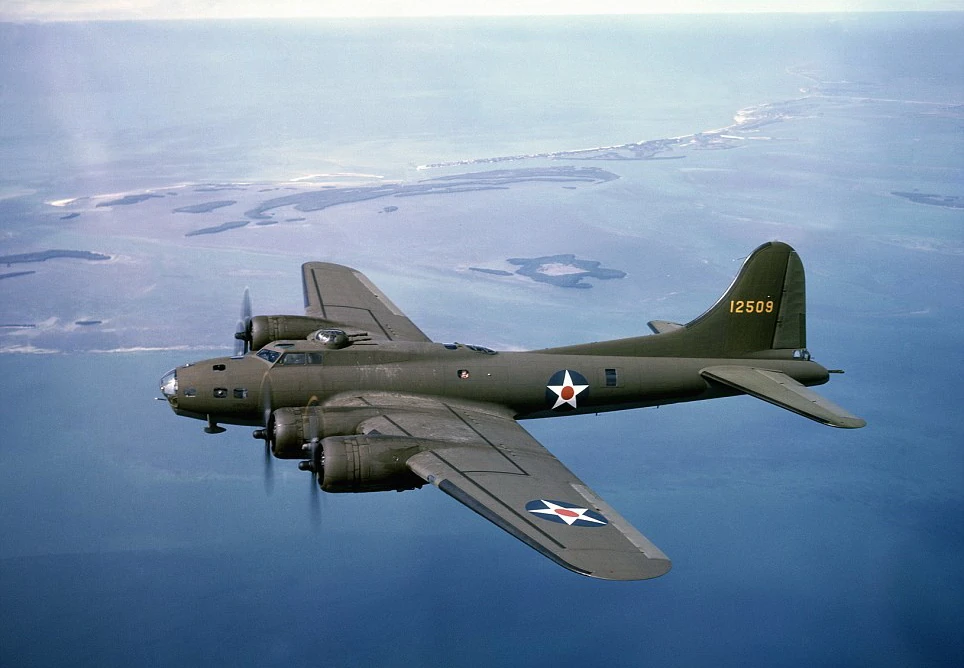

A B-17E flying over the Pacific Ocean.
The B-17 Flying Fortress is a heavy bomber designed by the Boeing Corporation that was used by the United States during World War II, as well as other belligerent nations.
Description[]
The first production model of the B-17 series was the B-17B model.[1] It had a crew of ten and four 1,200 hp, Wright R-1820-65 engines capable of propelling the B-17 at speeds of up to 462 km/h. The range was slightly over 3,200 km and it had a payload of approximately 2,700 kg. Equipped with seven .50 M2 Browning machine guns it could prove a dangerous adversary to opposing forces. An icon for its durability, the B-17 was used extensively used during World War II. However, it was quickly replace post-war due to multiple new advances in technology.
Variants[]
B-17B[]
Boeing Designation: Model 299E - later 299M.[2] Thirty nine examples ordered after successful testing of YiB-17 and Y1B-17A prototypes. Wright R-1820-51 engines with exhaust driven superchargers. [3] First flown 27 June 1939. Delivered between 29 July 1939 and 30 March 1940.[2]
B-17C (Fortress Mk I)[]
Boeing designation - Model 299H (USAAC) Model 299T (RAF). [2] Wright R-1820-65 engines. Gun armament increased from five to seven 0.3 in weapons. Side blisters replaced with plain openings. Up to twenty [2] ferried to UK for combat evaluation with 90 Squadron, RAF. Surviving aircraft upgraded to B-17D configuration.[3]
B-17D[]
B-17C with self-sealing tanks and armour protection for the crew.[3]
B-17E (Fortress Mk IIA)[]

A B-17E Flying Fortress.
Boeing Designation Model 299O. Extensive redesign with new tail assembly, consisting of extended dorsal fin, wider span tailplanes and a manually operated turret in tail with two 0.5 in machine guns. Two 0.3 in guns retained in nose, with all other 0.3 in guns replaced by 0.5 in guns - two in a Bendix turret behind the cockpit, two in the radio compartment, one on each side of the aft fuselage and two in a ventral ball turret just aft of the wing.[N 1] Standard crew increased from 9 to 10 men. All up weight was 54,000 lbs, and max speed was 317 mph. [5]
The first B-17E flew on September 5 1941.
In Mid 1942, Forty five examples were passed to RAF Coastal Command, who designated the type as the Fortress IIA. One aircraft, serial FK185, had the normal transparent nose fairing replaced with a Bristol B/16 turret housing a 40 mm Vickers 'S' gun for use against surfaced submarines. The gun had azimuth traverse of 30 degrees and elevation of 40 degrees.
A single B-17E (41-2593) was converted into a personnel transport aircraft, as the XC-108, for use by General Douglas MacArthur. All armour was removed, as well as all except nose and tail guns. Extra windows were fitted. The interior was arranged with office and living space.
Another B-17E (41-2595) was modified to carry heavy freight loads. Designates XC-108A, the aircraft was fitted with a large cargo door in the port fuselage, in order to test the concept of converting obsolescent bomber aircraft into air freighters. Gross weight reached 49,000 lbs.
A further B-17E (41-2401) was fitted with four 1,425 hp Allison V-1710-89 liquid cooled engines by the Vega company, becoming the XB-38. Apart from the revisions arising from the change in powerplant, the airframe had an airframe identical to a B-17E, and made its first flight with V-1710s on 19th May 1943. Max speed was 327 mph, and gross weight was 58,000 lb. Due to the demands on V-1710 production for P-38 Lightnings and P-40 Warhawks, and the loss of the XB-38 following an engine fire on 16th June 1943, work on the type was cancelled before a full comparison with the B-17E could be carried out.[6]
B-17F (Fortress Mk II)[]
Amended B-17E with additional fuel tanks in the wings, as well as external inner wing racks for a pair of 4,000 lb bombs. Later examples were fitted with R-1820-97 engines. Examples of the B-17F modified for Photographic Reconnaissance were designated F-9, and fitted with three cameras installed in the nose, and additional fuel tanks in the bomb bay. First conversion made by United Air Lines Modification Center at Cheyenne, Ohio, in January 1942. A special executive version of the B-17F, with deluxe furnishings and retaining some defensive armament, were operated under the designation YC-108.[3]
B-17G (Fortress Mk III)[]
Enhanced aircraft based on later B-17F. Armament increased by installation of a remotely controlled twin gun Bendix turret, fitted to the underside of the nose to replace the hand operated nose guns. Later examples had the hand operated nose guns restored, the open waist positions replaced by staggered enclosed waist positions, a new tail gun mounting which replaced the ring and bead sight with a reflector gunsight and provision for the carriage/operation of a pair of JB-2 flying bombs. These were started and launch by means of a control panel in the bombardier's compartment. Unarmed B-17Gs used for transport duty in Europe were designated CB-17.[3]
History[]
Prototypes[]
The B-17 was developed in response to a 1934 Army Air Corps specification[N 2] for a multi engined anti-shipping bomber.[8] It was designed for strategic bombing against Germany and was used, although to a significantly lesser extent, in the Pacific Theater due to it being replaced by the B-29 Superfortress. Construction of the first prototype began on August 16 1934 under the designation Model 299. The design was equipped with a wing spanning 103 ft 9 in which carried four 750 hp Pratt and Whitney Hornet R-1690-E nine cylinder radials. As a company owned aircraft, the B-299 was allocated the civil registration X-13372. The first flight was carried out by L. R. Tower on July 28th 1935, immediately demonstrating the superiority of its conception.
After a short period of factory testing, the aircraft was flown 2,100 miles non stop to Wright Field for evaluation by the Army Air Corps, where is demonstrated a max speed between 200 mph-250 mph at 10,000 ft, an operating speed of 170 mph-200 mph, service ceiling of between 20,000 ft-25,000 ft and endurance of between about 6 and 10 hours.[9]
Combat Service[]
The first examples of the B-17 to be used for combat missions were the twenty B-17C Fortress Mk I aircraft supplied to 90 Squadron RAF in May 1941, with operations commencing on July 8th.[2] Despite losses, the squadron had completed twenty-two attacks by September, before European operations were abandoned. Four of the Fortress Mk Is were sent to the Middle East, carrying out night attacks until May 1942. The remaining Fortress Mk Is in Europe were transferred to Coastal Command, carrying out maritime reconnaissance missions from Benbecula with 206 and 220 Squadrons. In July 1942, a single Fortress Mk I made its way to India, where it was taken into US service. [10]
Experimental Service[]
Some were converted into XB-40 escort aircraft, while at least 25 were turned into BQ-7 Aphrodite radio controlled missiles.
Use by Axis forces[]
At least 14[11] captured B-17s were operated by the Luftwaffe under the cover designation Do 200.[12]
Notes[]
References[]
- ↑ http://www.militaryfactory.com/aircraft/detail.asp?aircraft_id=79
- ↑ 2.0 2.1 2.2 2.3 2.4 Green, William. Famous Bombers. Page 49.
- ↑ 3.0 3.1 3.2 3.3 3.4 Bridgeman, Leonard. 1945/46 (1998). Page 210.
- ↑ Green, William. Famous Bombers. Page 52.
- ↑ Green, William. Famous Bombers. Page 53.
- ↑ Green, William. Famous Bombers. Page 54.
- ↑ Green, William. Famous Bombers. Page 44.
- ↑ Gunston, Bill. Directory Page 340.
- ↑ Green, William. Famous Bombers. Page 45.
- ↑ Green, William. Famous Bombers. Page 50.
- ↑ Gunston, Bill. St Michael Aircraft of World War 2. Octopus Books. 1982. ISBN 0-86273-014-7 Page 23
- ↑ Green, William. Famous Bombers. Pages 57-58.
| |||||||||||||||||||||||